PrintMakerAI vs Claude Import Memory
Side-by-side comparison of features, pros & cons, pricing, and community votes (2026).
🏆 Claude Import Memory leads with 716 upvotes
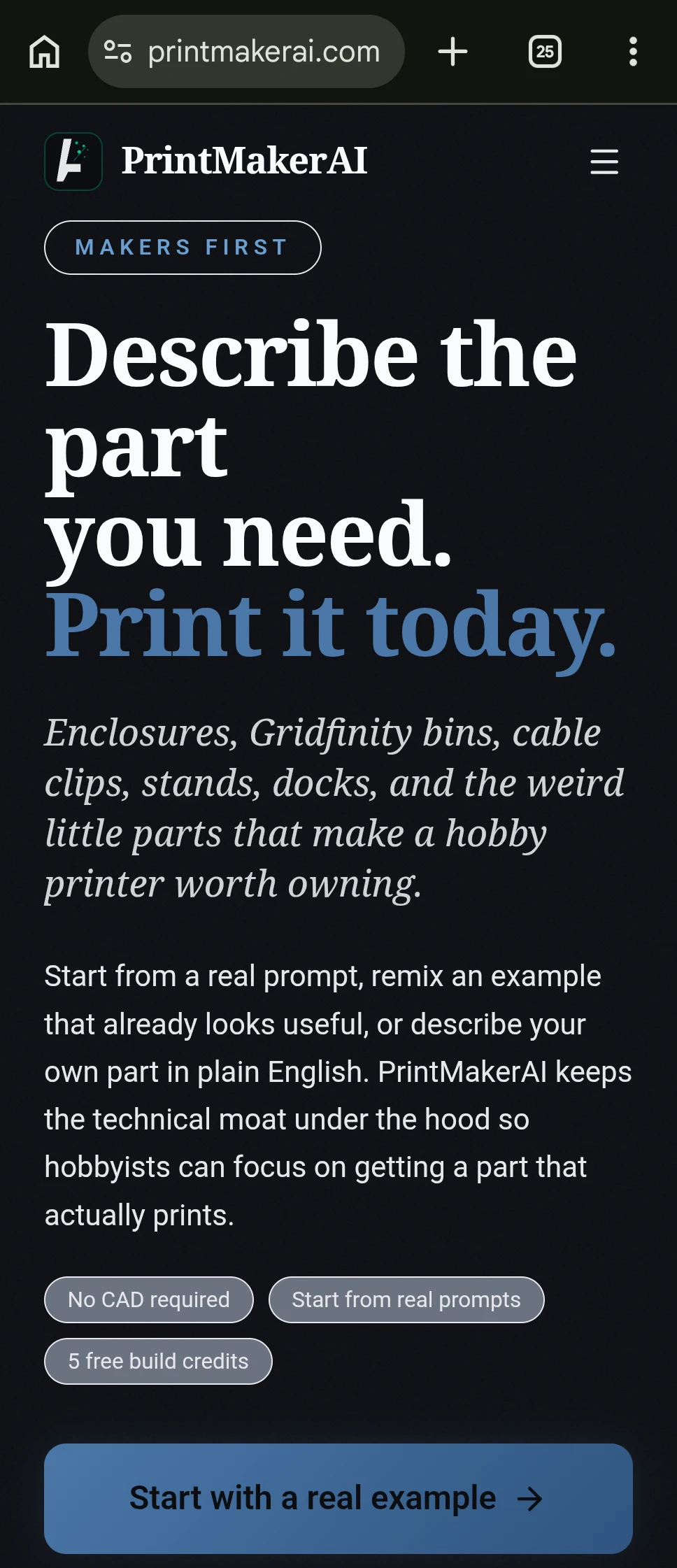
Describe a part. AI builds it, views it, fixes it & renders
PrintMakerAI is an innovative AI-driven 3D modeling tool designed for creators, engineers, and hobbyists who need to quickly generate printable parts from simple textual descriptions. By leveraging advanced AI vision, natural language processing, and the open-source OpenCascades Brep-Kernel, it allows users to describe components like enclosures, brackets, cable clips, and custom desk parts with plain English. The platform offers multiple input methods, including text prompts, drawing-to-CAD conversion, and phone-based object scanning, making 3D modeling more accessible and efficient. Its focus on DFM (Design for Manufacturing) checks ensures that the generated parts are ready for production, minimizing errors and reducing iteration time. Unlike generic AI wrappers, PrintMakerAI emphasizes organic shape development and detailed engineering validation, making it ideal for both prototyping and final production. Its unique combination of AI vision, natural language, and organic shape development sets it apart in the rapidly evolving maker and product development space.
Pros
- User-friendly interface supports plain English descriptions for complex part creation
- Multiple input methods including text, drawing, and object scanning
- Built-in DFM checks for manufacturability and quality assurance
- Focus on organic shapes and detailed engineering for final production
- Uses advanced open-source kernel for precise, organic geometry
Cons
- Currently in finalization phase for some features, like 'Enclose a Device'
- Limited user base and community support as it is a newer tool
- Pricing details are not publicly clear, potentially costly for some users
Best for
- • Designing custom enclosures for developer boards and electronics
- • Creating printable Gridfinity storage bins and organizational components
- • Developing cable management clips and brackets for desks
- • Rapid prototyping of organic-shaped mechanical parts
Pricing: Specific pricing details are not publicly available, but the tool likely offers a freemium model with basic features accessible for free and premium features or higher-resolution outputs available via paid plans.

Switch from ChatGPT to Claude with import memory feature
Claude Import Memory offers a seamless way for users to transition their AI workflows from other providers to Claude by importing preferences, projects, and contextual data with a simple copy-paste. This feature ensures that users can switch AI assistants without losing valuable insights or customization, making it ideal for businesses or individuals seeking continuity and efficiency. Its standout feature is the ability to quickly update Claude’s memory, allowing the AI to pick up right where the user left off, thereby saving time and maintaining productivity. Available on all paid plans, this tool emphasizes flexibility and ease of migration, making it attractive for users who want to switch AI providers without starting from scratch. With a user-friendly approach and robust memory transfer capabilities, Claude Import Memory enhances the overall AI experience by bridging the gap between different platforms effortlessly.
Pros
- Simple and quick memory import process with copy-paste functionality
- Ensures continuity by preserving preferences, projects, and context
- Available on all paid plans, making it accessible for various users
- Helps users switch AI providers without losing valuable data or customization
Cons
- Limited details on the extent of memory transfer capabilities
- Potential learning curve for new users unfamiliar with import procedures
- Dependent on paid plans; may not be available on free tiers
Best for
- • Switching from ChatGPT or other AI providers to Claude without losing context
- • Migrating ongoing projects to Claude for better integration
- • Consolidating AI workflows across multiple platforms
- • Preserving user preferences during platform upgrades or changes
Pricing: Likely operates on a subscription-based model with memory import features included in all paid plans, though specific pricing details are not publicly disclosed.