Ainux Domain Intelligence vs Claude Import Memory
Side-by-side comparison of features, pros & cons, pricing, and community votes (2026).
🏆 Claude Import Memory leads with 716 upvotes
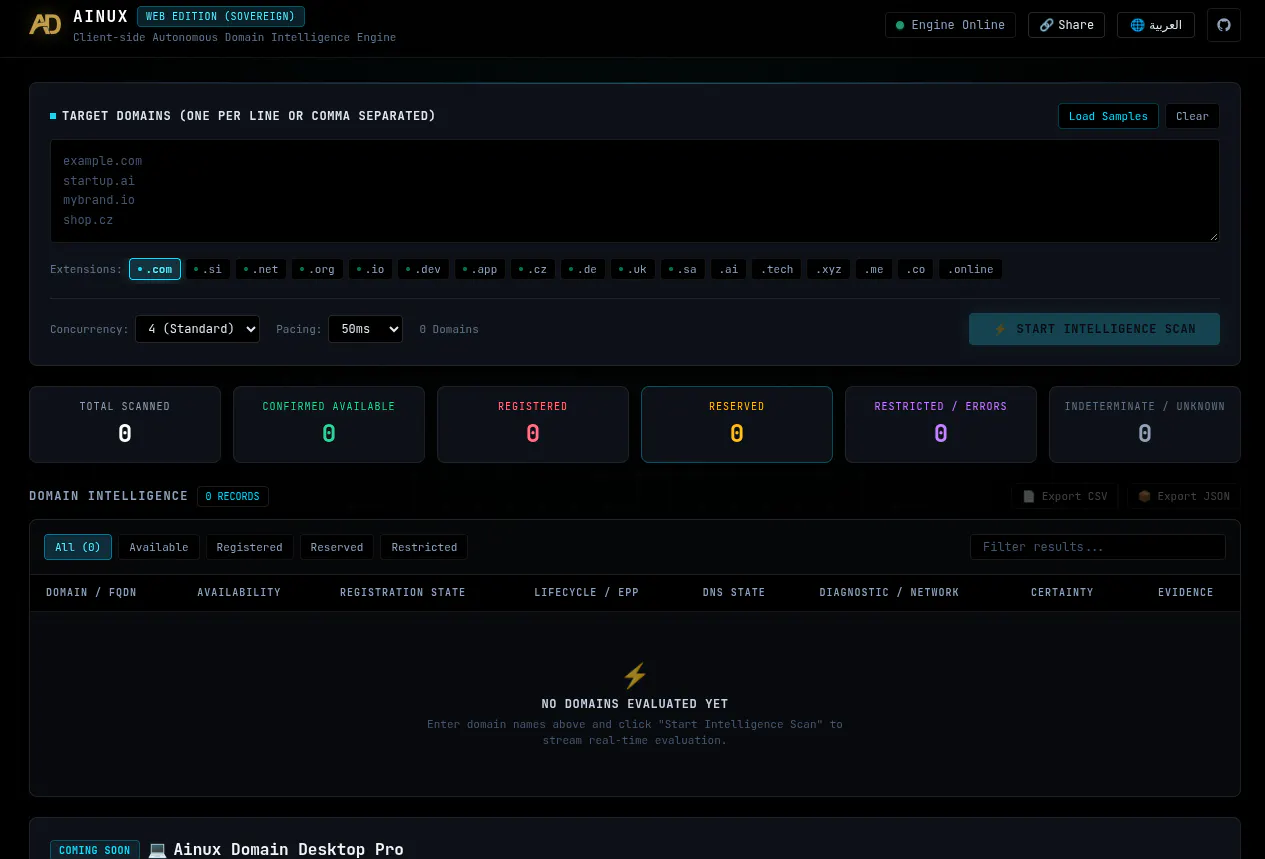
Privacy-first domain research, powered by WebAssembly
Ainux Domain Intelligence is a privacy-first domain research tool designed for professionals who need efficient and secure domain analysis. Built as a browser-native application, it leverages WebAssembly and Web Workers to run its core engine locally, ensuring that sensitive data remains private and does not pass through external servers. This architecture allows users to perform large-scale bulk domain scans—such as analyzing thousands of domains—in mere seconds, demonstrated by its ability to process 2,500 domains in just 37.7 seconds. Its emphasis on privacy, combined with high performance, makes it an attractive option for security researchers, digital marketers, and developers who prioritize data security and speed. The tool’s unique approach to local processing sets it apart in the domain research space, eliminating concerns about data leaks or reliance on third-party backend servers.
Pros
- Privacy-focused with local WebAssembly processing
- High-speed bulk domain scanning capabilities
- Browser-native, no installation required
- Supports large-scale domain research efficiently
- Reduces reliance on external backend servers for data processing
Cons
- Limited information on detailed feature set or integrations
- No user reviews or ratings available yet
- Potential learning curve for non-technical users
Best for
- • Bulk domain research for cybersecurity assessments
- • Digital marketing and SEO domain analysis
- • Brand monitoring and domain portfolio management
- • Competitive intelligence gathering
Pricing: Pricing not verified

Switch from ChatGPT to Claude with import memory feature
Claude Import Memory offers a seamless way for users to transition their AI workflows from other providers to Claude by importing preferences, projects, and contextual data with a simple copy-paste. This feature ensures that users can switch AI assistants without losing valuable insights or customization, making it ideal for businesses or individuals seeking continuity and efficiency. Its standout feature is the ability to quickly update Claude’s memory, allowing the AI to pick up right where the user left off, thereby saving time and maintaining productivity. Available on all paid plans, this tool emphasizes flexibility and ease of migration, making it attractive for users who want to switch AI providers without starting from scratch. With a user-friendly approach and robust memory transfer capabilities, Claude Import Memory enhances the overall AI experience by bridging the gap between different platforms effortlessly.
Pros
- Simple and quick memory import process with copy-paste functionality
- Ensures continuity by preserving preferences, projects, and context
- Available on all paid plans, making it accessible for various users
- Helps users switch AI providers without losing valuable data or customization
Cons
- Limited details on the extent of memory transfer capabilities
- Potential learning curve for new users unfamiliar with import procedures
- Dependent on paid plans; may not be available on free tiers
Best for
- • Switching from ChatGPT or other AI providers to Claude without losing context
- • Migrating ongoing projects to Claude for better integration
- • Consolidating AI workflows across multiple platforms
- • Preserving user preferences during platform upgrades or changes
Pricing: Likely operates on a subscription-based model with memory import features included in all paid plans, though specific pricing details are not publicly disclosed.