witr vs MuleRun
Side-by-side comparison of features, pros & cons, pricing, and community votes (2026).
🏆 MuleRun leads with 655 upvotes
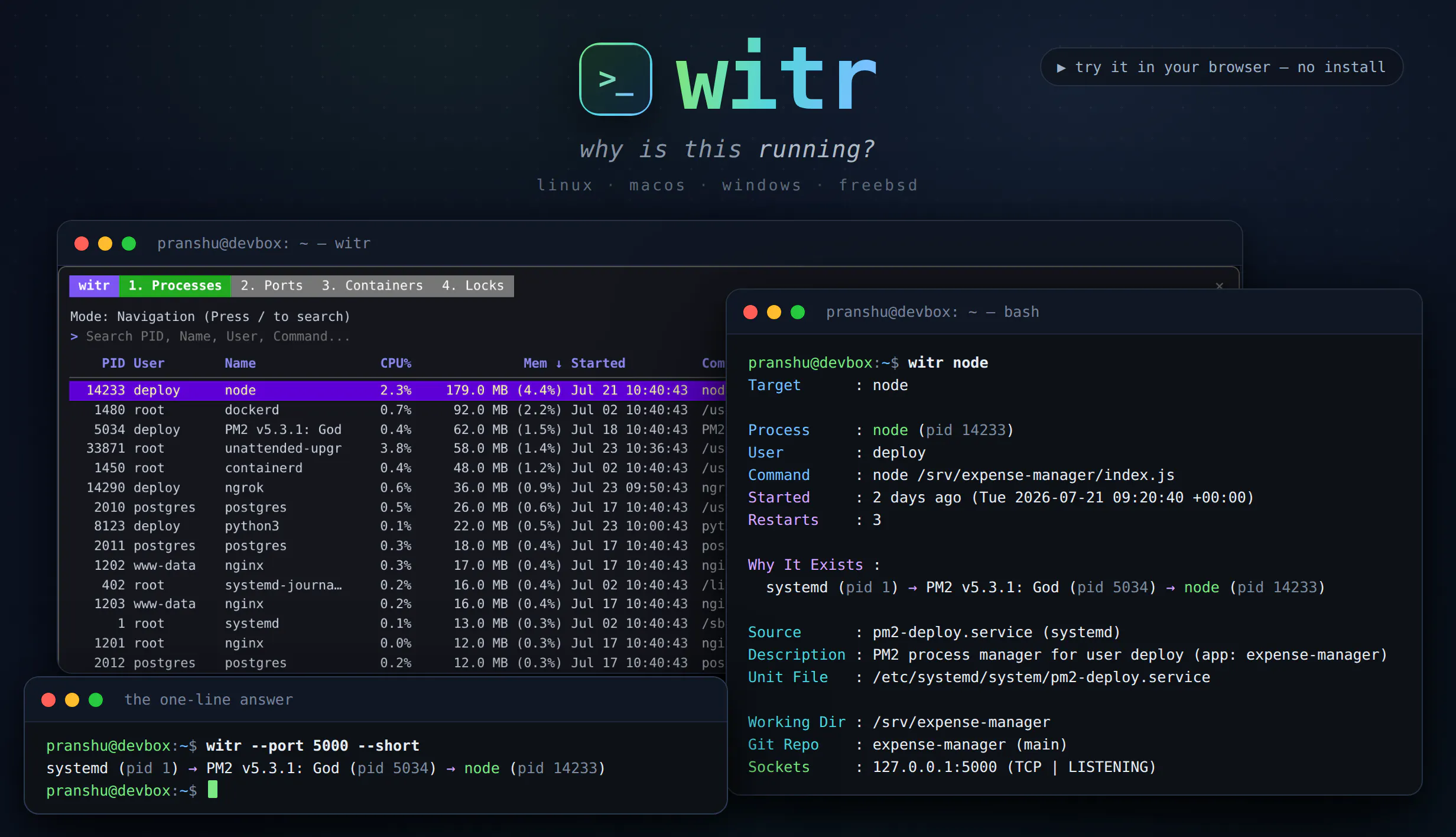
Why is this running? Trace process, port, container or file
Witr is a powerful diagnostic tool designed for developers, system administrators, and DevOps professionals who need to understand the origin and context of running processes on their systems. Unlike traditional commands like ps, top, or lsof that reveal what is running, Witr takes it a step further by explaining why a process is active. By pointing it at a process ID, port, container, or file, users can trace the entire chain—covering systemd, supervisor, shell, or cron—that led to its initiation. Its interactive TUI interface offers an intuitive way to explore processes, ports, containers, and locks, while scripting options allow for automation and integration into monitoring workflows. Available as a single static Go binary compatible across Linux, macOS, Windows, and BSD, Witr is both versatile and portable, making it ideal for troubleshooting complex environments and containerized setups. Its ability to provide detailed context and warnings makes it a standout tool for in-depth system analysis.
Pros
- Provides detailed process origin tracing beyond traditional commands
- Supports multiple platforms (Linux, macOS, Windows, BSD) with a single binary
- Interactive TUI for easy exploration and troubleshooting
- Flexible scripting options (--short, --json) for automation
- Open source and lightweight, suitable for integration into existing workflows
Cons
- Relatively new with limited community adoption and documentation
- May require familiarity with system internals for full benefit
- Lacks a graphical user interface, relying on command-line or TUI
Best for
- • Tracing the source of unexpected processes or services
- • Debugging container or systemd startup issues
- • Understanding process dependencies in complex environments
- • Monitoring process chains in automated or scheduled tasks
Pricing: Witr is open source and free to use, distributed as a single static binary for multiple operating systems. Its open-source nature makes it accessible without any licensing costs, though support or extended features may depend on community contributions or future updates.

Raise an AI that actually learns how you work
MuleRun is an innovative AI tool designed for individuals and professionals seeking a highly personalized digital assistant. Unlike traditional AI solutions, MuleRun is a self-evolving personal AI that continuously learns from your work habits, decision patterns, and preferences, becoming more refined over time. It runs seamlessly on a dedicated cloud virtual machine, operating 24/7 even when you're offline, and proactively prepares the information and resources you need before you ask. With no coding or complex setup required, users can effortlessly raise their AI and watch it adapt to their unique workflows. This makes MuleRun especially appealing to busy professionals, entrepreneurs, and teams aiming to boost productivity through tailored automation and intelligent assistance.
Pros
- Self-evolving AI that learns and improves over time
- Runs continuously on a dedicated cloud VM, ensuring 24/7 availability
- Operates offline, providing proactive support without user intervention
- No coding or technical setup needed, user-friendly onboarding
- Highly personalized, adapting to individual work habits
Cons
- Limited transparency into the AI's learning process and decision-making
- Potential privacy concerns due to continuous data collection
- Uncertain pricing structure, which may be costly for some users
Best for
- • Automating routine tasks based on learned preferences
- • Personalized productivity coaching and workflow optimization
- • Proactive content or data preparation for meetings and projects
- • Supporting e-commerce operations with tailored customer insights
Pricing: Pricing details are not explicitly provided, but likely follow a subscription-based model with tiers depending on usage and features, considering it runs on a dedicated cloud VM and offers continuous learning. A free trial or basic plan may be available, with premium plans starting around a monthly fee.