Maths3D vs BrainLoom
Side-by-side comparison of features, pros & cons, pricing, and community votes (2026).
🏆 BrainLoom leads with 302 upvotes
Real Maths. Real Places.
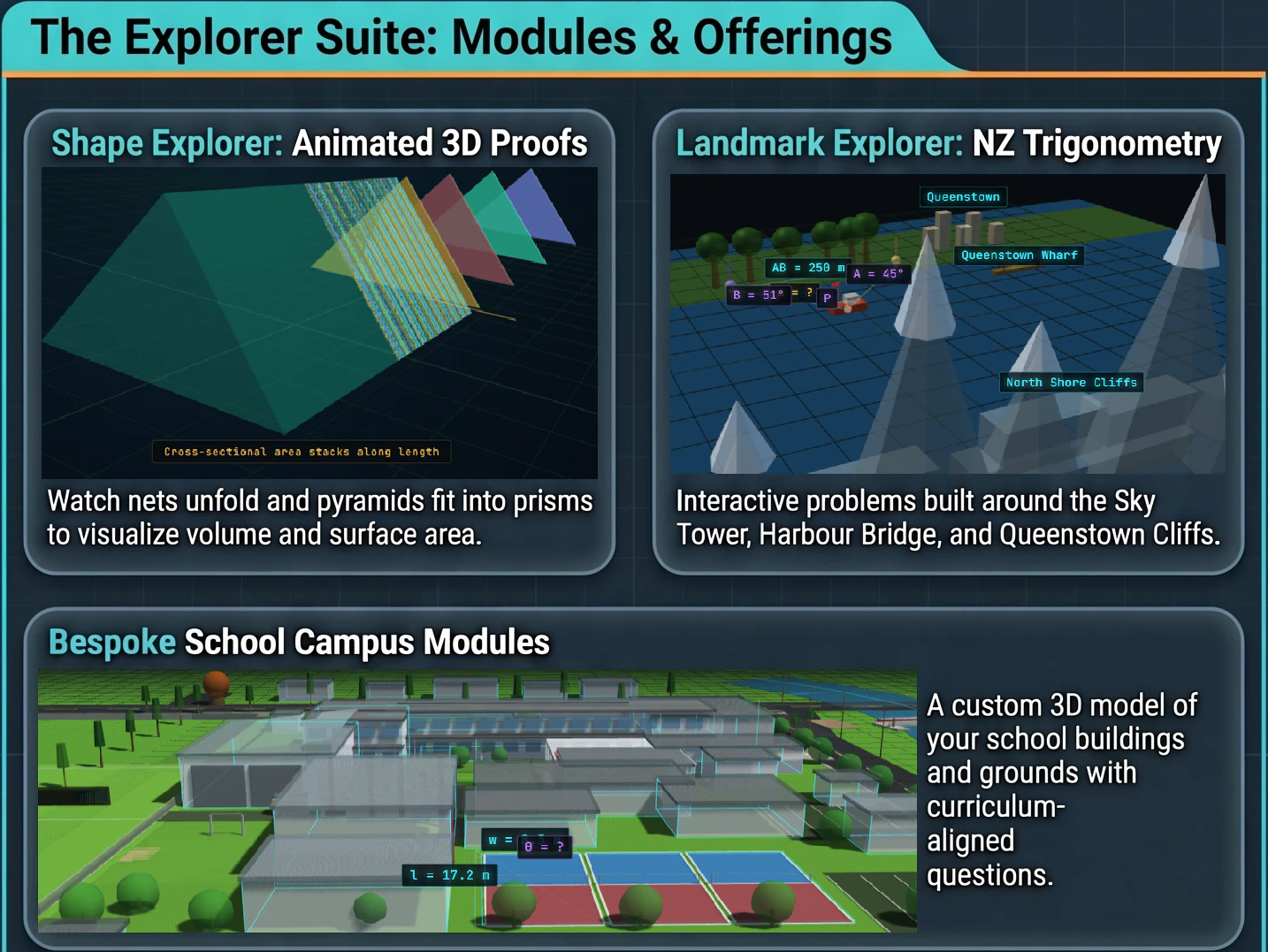
Maths3D is an innovative educational tool designed to bring advanced geometry and trigonometry concepts to life through interactive 3D visualizations. Catering primarily to students studying NCEA, Singapore MOE, and US Common Core curricula, it offers a dynamic way to explore surface areas, volumes, and key theorems related to 3D shapes and triangles. The platform's unique feature set includes animated derivations, realistic representations of Platonic shapes, and visualizations of famous landmarks, making complex mathematical ideas more engaging and accessible. By integrating real-world landmarks with mathematical concepts, Maths3D helps students develop a deeper understanding while maintaining an enjoyable learning experience. Its user-friendly interface and focus on visual learning make it a valuable resource for both classroom use and individual study, especially for visual and kinesthetic learners.
Pros
- Interactive 3D visualizations enhance conceptual understanding
- Supports multiple curricula (NCEA, Singapore MOE, US Common Core)
- Includes animated derivations for better comprehension
- Free for students, making it accessible to a wide audience
- Engages learners with real-world landmarks and applications
Cons
- Limited information on advanced customization or teacher tools
- Potentially steep learning curve for younger students unfamiliar with 3D concepts
- No details on offline access or integration with other educational platforms
Best for
- • Teaching 3D geometry and surface area concepts in classrooms
- • Supplementing online or remote learning for math courses
- • Visualizing complex shapes and theorems for better retention
- • Engaging students with real-world applications of math
Pricing: Maths3D is free for students, making it highly accessible. There is no mention of paid plans or premium features, suggesting it may operate primarily as a free resource supported by educational initiatives or grants.

Turn PDFs into Flashcards. The local-first Learning OS.
BrainLoom is a local-first learning platform designed to streamline the study workflow by consolidating multiple tools into one. It allows users to instantly convert PDF highlights into flashcards, maintaining direct links to source texts for deep contextual understanding. Its unique 'Smart Paste' feature enables users to visually organize ideas on an Infinite Canvas without needing to touch a mouse, making it ideal for visual thinkers and students who want an integrated, efficient study environment. Currently available for Windows with a Mac version upcoming, BrainLoom aims to eliminate app switching and enhance learning productivity. Its user-friendly interface and focus on local-first data management make it a compelling choice for learners and educators seeking a unified, efficient study tool.
Pros
- Local-first design ensures data privacy and quick access without reliance on cloud services
- Instant PDF highlight-to-flashcard conversion saves time and effort
- Visual organization with Infinite Canvas enhances idea structuring
- Deep linking maintains context and source connections for better comprehension
- All-in-one platform reduces need for multiple study apps
Cons
- Limited to Windows currently, with Mac support coming soon
- May have a learning curve for users unfamiliar with visual note-taking tools
- Pricing details are not fully transparent, potentially limiting initial adoption
Best for
- • Creating flashcards directly from PDF study materials
- • Organizing complex ideas visually on an Infinite Canvas for projects or planning
- • Studying for exams by linking source texts with review cards
- • Research workflows that require linking notes to original sources
Pricing: Based on the description, BrainLoom likely offers a lifetime license at a one-time fee of $29 for early adopters, with future plans potentially including a subscription model for ongoing updates. As a new product, it emphasizes affordability for initial users, but detailed pricing tiers are not yet publicly specified.