LiveProof vs Visual Translate by Vozo
Side-by-side comparison of features, pros & cons, pricing, and community votes (2026).
🏆 Visual Translate by Vozo leads with 766 upvotes
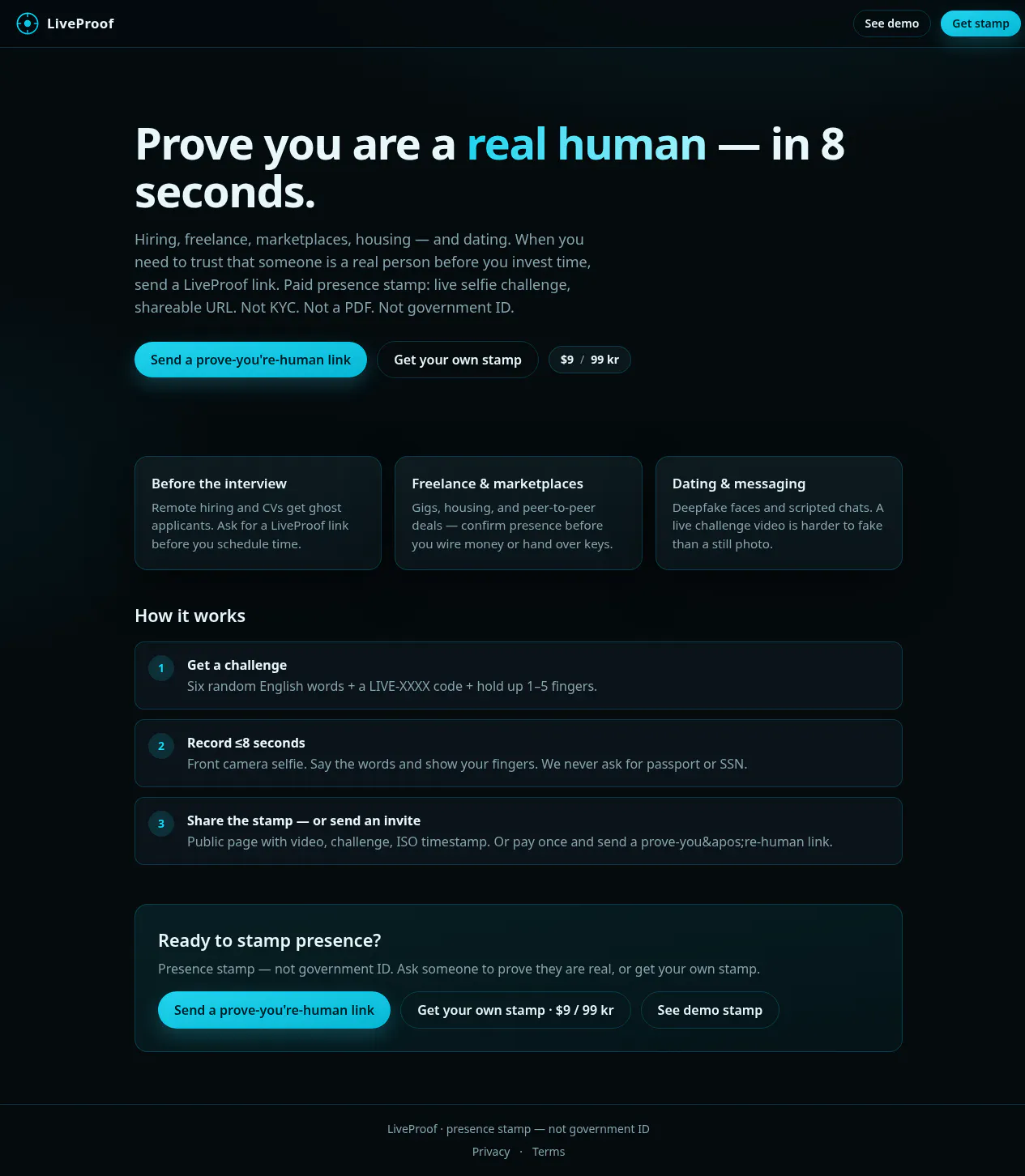
Prove you're a real human — in about 8 seconds
LiveProof is a innovative SaaS tool designed to verify human presence through quick, shareable videos. Users record a short selfie clip, pay a one-time fee, and receive a link that confirms they were present at a specific moment. Its primary focus is on providing a simple, non-invasive form of proof that someone is a real person, suitable for remote interactions, asynchronous deals, or quick identity verifications. Unlike traditional KYC or government ID checks, LiveProof emphasizes speed, ease, and privacy, making it ideal for businesses and individuals who need a lightweight verification method without extensive data collection. Its user-friendly approach makes it accessible for a wide range of remote workflows, from client check-ins to casual verification scenarios.
Pros
- Fast verification process—proof in about 8 seconds
- Shareable link for easy distribution and proof collection
- Privacy-focused, not relying on sensitive government IDs
- Simple to use, no complex setup or integrations required
- Versatile for various remote and asynchronous use cases
Cons
- Limited to verifying presence at a specific moment, not identity validation
- May not be suitable for high-security or official verification needs
- Dependent on user willingness to record a selfie video
Best for
- • Remote check-ins for remote teams or clients
- • Verifying real presence during online transactions or deals
- • Asynchronous confirmation of attendance at events or meetings
- • Quick identity checks for freelance or gig work
Pricing: Pricing not verified

Translate text in your videos without recreating visuals
Visual Translate by Vozo is a groundbreaking SaaS tool designed to simplify the process of creating multilingual videos by translating on-screen text without the need to recreate visuals. It seamlessly detects and translates text embedded within videos—such as slides, callouts, labels, and diagrams—while maintaining the original layout, style, and animations. This makes it an ideal solution for content creators, educators, marketers, and businesses aiming to reach a global audience without the time-consuming process of re-editing videos from scratch. By integrating voice dubbing, lip-sync, and subtitle translation, Visual Translate offers a comprehensive approach to multilingual video localization, saving users significant time and effort while expanding their reach.
Pros
- Automates on-screen text detection and translation, saving time
- Preserves original visual style, layout, and animations
- Enables quick creation of multilingual videos without re-editing
- Supports a variety of video types like slides and explainers
- Enhances global reach with minimal effort
Cons
- May have limitations with complex or heavily animated visuals
- Exact pricing details are unclear, potentially costly for large volumes
- Relies on accurate text detection, which can vary with video quality
Best for
- • Converting educational videos into multiple languages for international students
- • Localizing marketing or product demo videos for global markets
- • Translating corporate training videos and webinars
- • Creating multilingual presentations without recreating visuals
Pricing: Likely operates on a subscription or pay-per-video model, typical for SaaS translation tools. Exact pricing details are not specified, but users can expect tiered plans based on video volume and features, with free trials or demos possibly available.