jev-seo vs Inspector
Side-by-side comparison of features, pros & cons, pricing, and community votes (2026).
🏆 Inspector leads with 621 upvotes
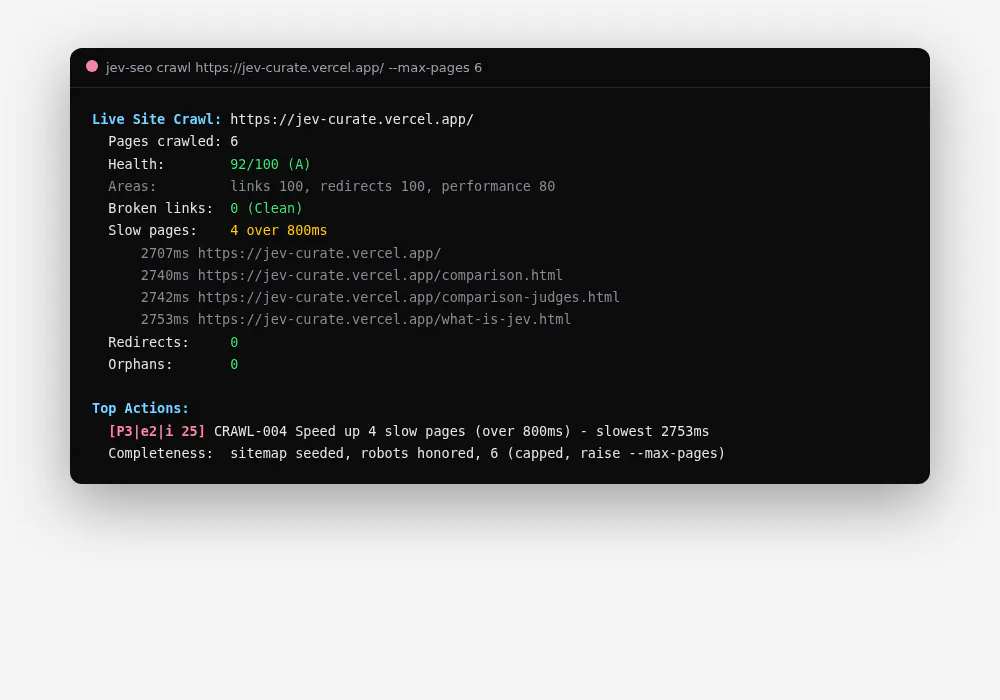
Free Rust CLI SEO/GEO auditor, no subscription needed
Jev-seo is an innovative free Rust CLI tool designed for SEO and GEO auditing, offering a compelling alternative to expensive SaaS solutions like Semrush and Ahrefs. It enables users to perform essential site audits—such as crawling, meta tag analysis, schema validation, robots.txt checks, and sitemap verification—without requiring subscriptions or paid API keys. Its command-line interface makes it particularly appealing for developers and technical SEO professionals seeking a lightweight, efficient, and cost-effective solution. Additionally, jev-seo offers optional semantic scoring powered by Jev, including intent classification and GEO/AI citation scoring, which requires a free API key. The tool can also be deployed as an MCP server for coding agents, further extending its flexibility and integration capabilities. Overall, jev-seo stands out as a highly accessible, developer-friendly option for rigorous site analysis, especially for those comfortable working in a CLI environment.
Pros
- Free and no subscription required for core features
- Lightweight and fast CLI-based tool suitable for developers
- Comprehensive core checks including crawling, schema validation, and sitemap analysis
- Optional semantic scoring enhances analysis with AI-powered insights
- Can be deployed as an MCP server for automation and integration
Cons
- Requires familiarity with command-line interfaces and Rust installation
- Advanced features like semantic scoring need an API key, which may involve manual setup
- Limited user interface—less accessible for non-technical users
Best for
- • Performing quick, cost-effective SEO audits for small to medium websites
- • Integrating site crawling and validation into CI/CD pipelines
- • Conducting GEO-specific SEO checks for localized content
- • Automating schema and meta tag validation during development
Pricing: Pricing not verified

Figma for Claude Code
Inspector reimagines the design-to-code workflow by integrating visual editing directly with AI-powered code generation. Designed for developers, designers, and product teams, it allows users to click on UI elements within a design interface, make visual adjustments, and have those changes automatically reflected in the underlying codebase. The tool connects seamlessly with popular AI agents like Claude Code, Codex, and Cursor, streamlining the often tedious handoff process between design and development. Its unique approach eliminates the need for manual code edits or back-and-forth communication, enabling rapid prototyping and iteration. By bridging the gap between visual design and code, Inspector enhances productivity and fosters a more collaborative workflow, making it ideal for teams seeking to accelerate their development cycles with AI-powered precision.
Pros
- Intuitive visual interface for code adjustments
- Seamless integration with popular AI coding agents
- Reduces manual coding and design handoff time
- Supports rapid prototyping and iteration
- Streamlines collaboration between designers and developers
Cons
- May have limitations with complex UI components
- Dependent on AI accuracy, which can vary
- Learning curve for users unfamiliar with AI-assisted editing
Best for
- • Quick UI tweaks during product development
- • Design validation and iteration without extensive code changes
- • Bridging the gap between design and development teams
- • Rapid prototyping of new features
Pricing: Likely operates on a freemium model, offering basic features for free with paid plans providing additional integrations and advanced editing capabilities; exact pricing details are not publicly specified.