DevTools Suite vs Inspector
Side-by-side comparison of features, pros & cons, pricing, and community votes (2026).
🏆 Inspector leads with 621 upvotes
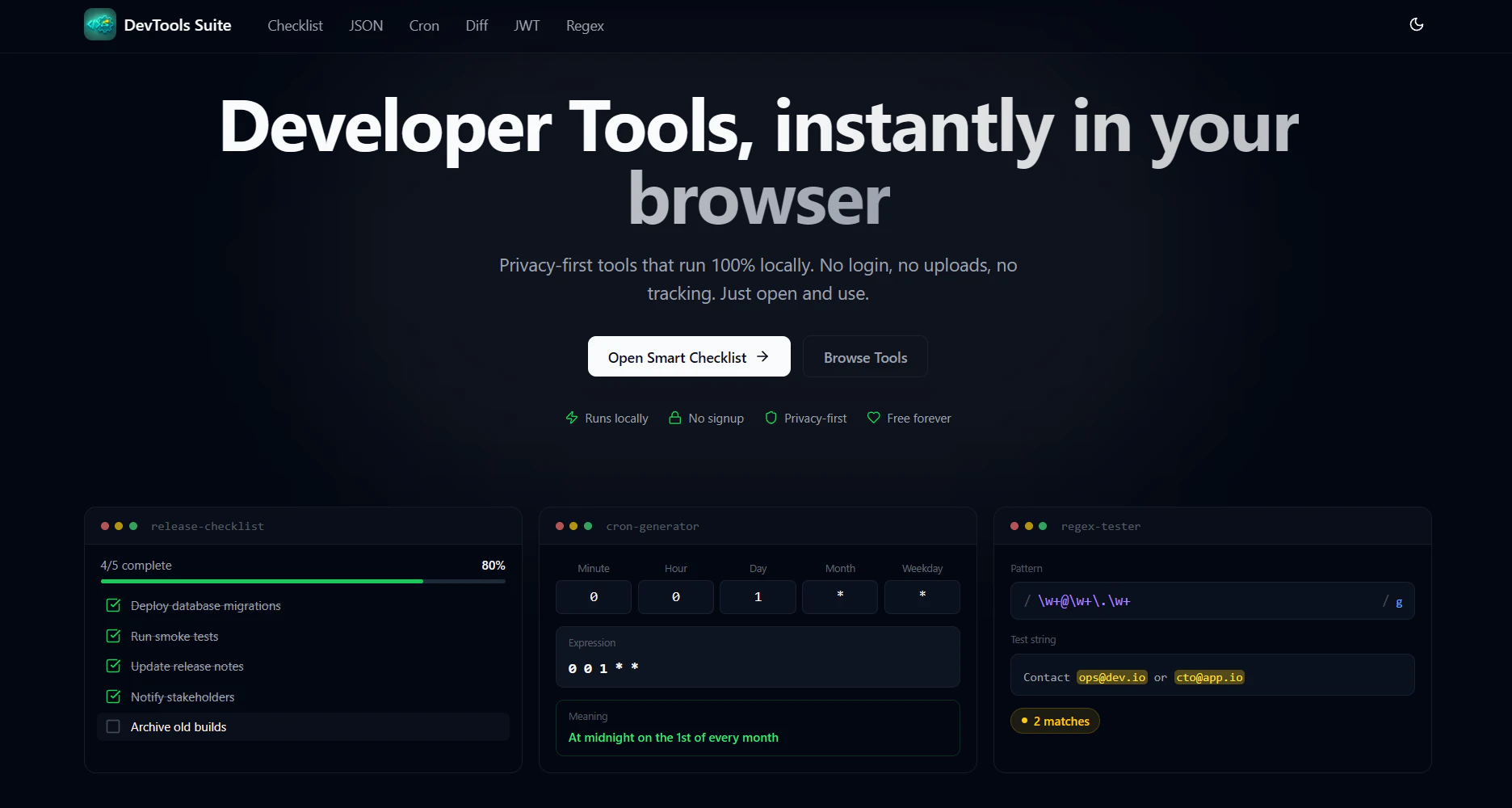
Privacy-first dev tools run in browser. No login no tracking
DevTools Suite is a collection of privacy-focused developer tools designed to run entirely within the browser, making them accessible and secure for developers who value data privacy. It offers a range of utilities including a JSON formatter & validator, JWT decoder, regex tester, cron expression generator, diff checker, and a smart checklist. Unlike many developer tools that require account creation or uploads, DevTools Suite emphasizes a login-free, no-tracking experience, ensuring users’ data remains private and their workflows uninterrupted. Its open-source nature and browser-based operation make it ideal for developers seeking quick, reliable tools without the hassle of installations or privacy concerns. Whether debugging JSON data, verifying JWT tokens, testing regular expressions, or generating cron schedules, this suite provides a simple yet powerful set of utilities, streamlining common development tasks efficiently.
Pros
- Privacy-first approach with no login or data tracking
- All tools run directly in the browser, no installation needed
- Wide range of developer utilities in a single suite
- Open source and free to use
- Accessible from any device with internet access
Cons
- Limited advanced features compared to dedicated, platform-specific tools
- No integration with other development environments or IDEs
- Lacks collaborative or team features
Best for
- • Quickly formatting and validating JSON data during API development
- • Decoding JWT tokens for authentication debugging
- • Testing regular expressions for data validation
- • Generating cron expressions for scheduling tasks
Pricing: Likely free and open source, emphasizing a privacy-first, no-cost utility suite with no paid plans or premium features.

Figma for Claude Code
Inspector reimagines the design-to-code workflow by integrating visual editing directly with AI-powered code generation. Designed for developers, designers, and product teams, it allows users to click on UI elements within a design interface, make visual adjustments, and have those changes automatically reflected in the underlying codebase. The tool connects seamlessly with popular AI agents like Claude Code, Codex, and Cursor, streamlining the often tedious handoff process between design and development. Its unique approach eliminates the need for manual code edits or back-and-forth communication, enabling rapid prototyping and iteration. By bridging the gap between visual design and code, Inspector enhances productivity and fosters a more collaborative workflow, making it ideal for teams seeking to accelerate their development cycles with AI-powered precision.
Pros
- Intuitive visual interface for code adjustments
- Seamless integration with popular AI coding agents
- Reduces manual coding and design handoff time
- Supports rapid prototyping and iteration
- Streamlines collaboration between designers and developers
Cons
- May have limitations with complex UI components
- Dependent on AI accuracy, which can vary
- Learning curve for users unfamiliar with AI-assisted editing
Best for
- • Quick UI tweaks during product development
- • Design validation and iteration without extensive code changes
- • Bridging the gap between design and development teams
- • Rapid prototyping of new features
Pricing: Likely operates on a freemium model, offering basic features for free with paid plans providing additional integrations and advanced editing capabilities; exact pricing details are not publicly specified.