DevHub Toolkit vs Inspector
Side-by-side comparison of features, pros & cons, pricing, and community votes (2026).
🏆 Inspector leads with 621 upvotes
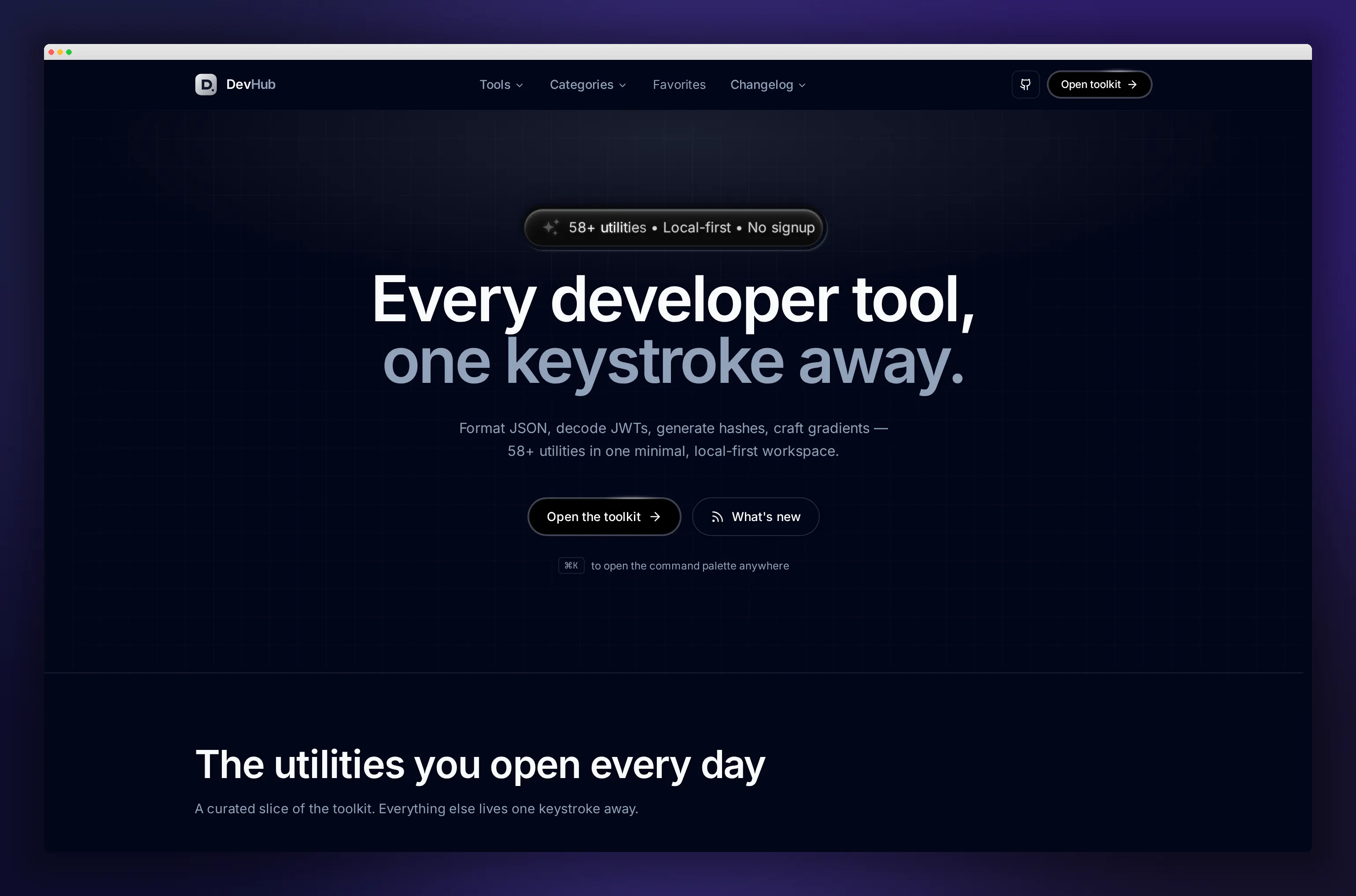
Every developer tool, one keystroke away
DevHub Toolkit is a highly versatile, keyboard-centric workspace designed specifically for developers who prioritize speed and efficiency. With over 55 utilities integrated into a minimal, client-side interface, it consolidates essential developer tools such as JSON formatting, JWT handling, SQL queries, regex testing, mock data generation, diff comparison, design elements like mesh gradients and favicon packs, plus AI helpers — all accessible with a simple ⌘K shortcut. Its zero-upload, no-signup approach ensures instant access and privacy, making it ideal for developers seeking a quick, clutter-free environment. The toolkit’s breadth of features and emphasis on keyboard navigation streamline workflows, saving valuable time and enabling faster problem-solving during coding, debugging, or design tasks. Its clean, minimal design and focus on essential utilities make it a compelling choice for developers who want a powerful yet unobtrusive workspace.
Pros
- Extensive collection of developer utilities in one lightweight workspace
- Keyboard-first interface enhances speed and efficiency
- No signup or upload required, ensuring privacy and instant access
- Client-side operation guarantees fast performance and security
- Highly customizable for different development workflows
Cons
- Lacks advanced collaboration features for team projects
- Primarily suited for individual use, limited integrations
- Steeper learning curve for users unfamiliar with keyboard shortcuts
Best for
- • Quick JSON formatting and validation during API development
- • Testing and generating JWT tokens for authentication workflows
- • Running SQL queries directly within the workspace
- • Testing regex patterns for data validation
Pricing: Likely operates on a freemium model, offering core utilities for free with optional paid plans for additional features or pro integrations. Exact pricing details are not publicly specified.

Figma for Claude Code
Inspector reimagines the design-to-code workflow by integrating visual editing directly with AI-powered code generation. Designed for developers, designers, and product teams, it allows users to click on UI elements within a design interface, make visual adjustments, and have those changes automatically reflected in the underlying codebase. The tool connects seamlessly with popular AI agents like Claude Code, Codex, and Cursor, streamlining the often tedious handoff process between design and development. Its unique approach eliminates the need for manual code edits or back-and-forth communication, enabling rapid prototyping and iteration. By bridging the gap between visual design and code, Inspector enhances productivity and fosters a more collaborative workflow, making it ideal for teams seeking to accelerate their development cycles with AI-powered precision.
Pros
- Intuitive visual interface for code adjustments
- Seamless integration with popular AI coding agents
- Reduces manual coding and design handoff time
- Supports rapid prototyping and iteration
- Streamlines collaboration between designers and developers
Cons
- May have limitations with complex UI components
- Dependent on AI accuracy, which can vary
- Learning curve for users unfamiliar with AI-assisted editing
Best for
- • Quick UI tweaks during product development
- • Design validation and iteration without extensive code changes
- • Bridging the gap between design and development teams
- • Rapid prototyping of new features
Pricing: Likely operates on a freemium model, offering basic features for free with paid plans providing additional integrations and advanced editing capabilities; exact pricing details are not publicly specified.