DevHub Toolkit vs 1Code
Side-by-side comparison of features, pros & cons, pricing, and community votes (2026).
🏆 1Code leads with 598 upvotes
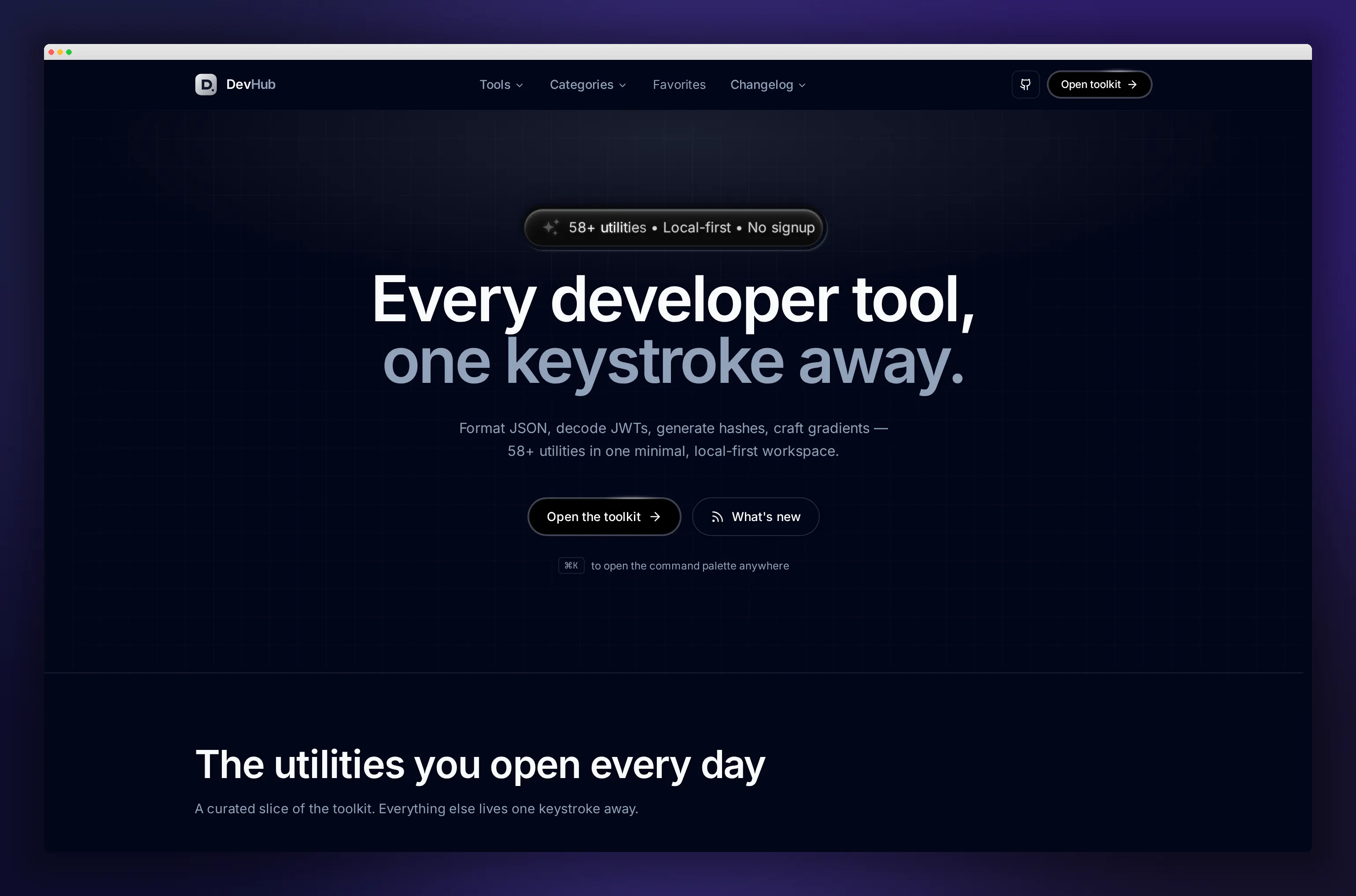
Every developer tool, one keystroke away
DevHub Toolkit is a highly versatile, keyboard-centric workspace designed specifically for developers who prioritize speed and efficiency. With over 55 utilities integrated into a minimal, client-side interface, it consolidates essential developer tools such as JSON formatting, JWT handling, SQL queries, regex testing, mock data generation, diff comparison, design elements like mesh gradients and favicon packs, plus AI helpers — all accessible with a simple ⌘K shortcut. Its zero-upload, no-signup approach ensures instant access and privacy, making it ideal for developers seeking a quick, clutter-free environment. The toolkit’s breadth of features and emphasis on keyboard navigation streamline workflows, saving valuable time and enabling faster problem-solving during coding, debugging, or design tasks. Its clean, minimal design and focus on essential utilities make it a compelling choice for developers who want a powerful yet unobtrusive workspace.
Pros
- Extensive collection of developer utilities in one lightweight workspace
- Keyboard-first interface enhances speed and efficiency
- No signup or upload required, ensuring privacy and instant access
- Client-side operation guarantees fast performance and security
- Highly customizable for different development workflows
Cons
- Lacks advanced collaboration features for team projects
- Primarily suited for individual use, limited integrations
- Steeper learning curve for users unfamiliar with keyboard shortcuts
Best for
- • Quick JSON formatting and validation during API development
- • Testing and generating JWT tokens for authentication workflows
- • Running SQL queries directly within the workspace
- • Testing regex patterns for data validation
Pricing: Likely operates on a freemium model, offering core utilities for free with optional paid plans for additional features or pro integrations. Exact pricing details are not publicly specified.

Open source Cursor-like UI for Claude Code
1Code is an innovative open source UI tool designed for developers working with Claude Code, an AI coding assistant. It offers a Cursor-like interface that enables users to run multiple Claude Code agents simultaneously, significantly accelerating feature development and testing. Available on Mac and Web, 1Code provides the flexibility to run locally or remotely, with live previews for mobile and desktop, making it easy to monitor agents from anywhere. Its parallel execution capability is particularly beneficial for teams seeking to streamline AI-driven coding workflows, enabling faster iteration and more efficient collaboration. The tool's user-friendly interface and cross-platform support make it an appealing choice for AI developers, coding enthusiasts, and teams integrating Claude Code into their development stacks.
Pros
- Supports parallel execution of multiple Claude Code agents, boosting productivity
- Cross-platform compatibility: works on Mac and Web with live preview features
- Open source, allowing for customization and community-driven improvements
- User-friendly, Cursor-like UI simplifies managing multiple agents
- Enables remote monitoring and testing, including mobile previews
Cons
- Primarily focused on Claude Code, limiting versatility with other AI models
- May require some technical expertise to set up and customize
- Limited detailed documentation available for advanced features
Best for
- • Parallel testing and debugging of AI coding agents
- • Accelerating feature development with multiple Claude Code instances
- • Remote monitoring of AI agents during development on multiple devices
- • Integrating AI code assistants into local and cloud-based workflows
Pricing: Likely free and open source, offering users the ability to customize and deploy without licensing costs. Additional features or enterprise support may be available through community or third-party services.