ClarityCommerce vs Your Next Store
Side-by-side comparison of features, pros & cons, pricing, and community votes (2026).
🏆 Your Next Store leads with 361 upvotes
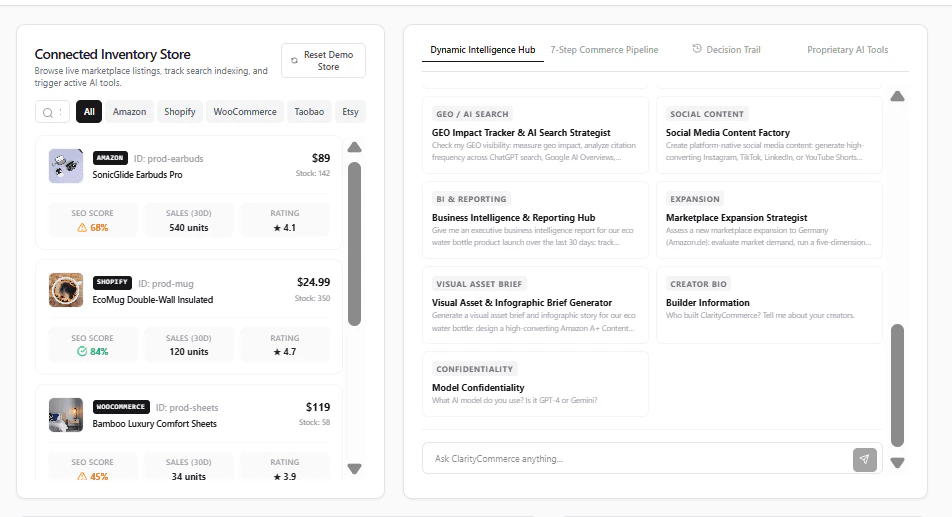
AI Commrce Engine with Explainable Reasoning & Flat Pricing.
ClarityCommerce is an innovative AI-powered e-commerce automation platform designed for online store owners seeking to optimize their operations effortlessly. With its focus on transparency and affordability at just $9.90 per month, it offers a suite of features including dynamic price optimization, automated product listing creation, and competitor analysis. Its explainable reasoning engine ensures users understand the AI's suggestions, fostering trust and better decision-making. The platform is ideal for small to medium-sized e-commerce businesses looking to leverage AI without complex integrations or high costs. What sets ClarityCommerce apart is its flat pricing model—no credits or hidden fees—and its emphasis on genuine AI automation, making advanced e-commerce tools accessible to a broader audience. Whether you're looking to boost sales, improve product listings, or stay ahead of competitors, ClarityCommerce provides a straightforward, cost-effective solution for modern online stores.
Pros
- Affordable flat-rate pricing with no credits or hidden fees
- Explainable AI reasoning builds trust and transparency
- Automates key e-commerce tasks like pricing and listings
- User-friendly interface suitable for small to medium businesses
- All-in-one platform covering analytics, automation, and competitor insights
Cons
- Limited information on advanced customization options
- Currently has no user reviews or high adoption metrics available
- Features may be basic compared to enterprise-level tools
Best for
- • Automating and optimizing product pricing strategies
- • Generating compelling product listings quickly
- • Monitoring and analyzing competitor pricing and listings
- • Identifying market trends through analytics
Pricing: Likely a straightforward subscription model at $9.90/month with no credits, aimed at small to medium-sized e-commerce businesses. No free tier is explicitly mentioned, but the flat pricing makes it simple and predictable for users.

AI-first platform for building commerce stores, fast
Your Next Store (YNS) is an innovative AI-first platform designed for rapid creation of commerce stores, targeting agencies, developers, and brands seeking a design-forward, customizable e-commerce solution. By leveraging AI-driven chat interfaces, users can effortlessly build their stores, while the underlying architecture is built on a well-structured, Stripe-native Next.js application. This setup ensures production-ready performance, full code ownership, and seamless integration with AI workflows like Codex and Claude Code, making it ideal for those who want both flexibility and automation in their commerce operations. The platform’s focus on opinionated, well-modeled commerce primitives simplifies complex tasks and accelerates deployment, positioning itself as a future-proof solution for agentic commerce building where intelligent agents can reason, build, and operate stores efficiently.
Pros
- AI-powered store creation for quick and intuitive setup
- Fully customizable, code-owning Next.js architecture
- Stripe-native and production-ready for seamless payments
- Integrates easily with AI workflows and code generation tools
- Designed for agencies and teams building scalable, design-forward brands
Cons
- May have a steep learning curve for non-technical users
- Dependence on AI chat interaction might limit customization for some users
- Limited information on pricing tiers and plans
Best for
- • Launching quick prototype stores for clients using AI chat
- • Building scalable e-commerce platforms for design-forward brands
- • Automating store management and updates with AI workflows
- • Developing custom integrations via well-modeled commerce APIs
Pricing: Likely operates on a SaaS subscription model with tiered plans, possibly including a free or trial option, and paid plans starting around a few hundred dollars per month depending on features and scale. Exact details are not specified but are typical for developer-centric platforms.