Bling vs Offsite
Side-by-side comparison of features, pros & cons, pricing, and community votes (2026).
🏆 Offsite leads with 578 upvotes
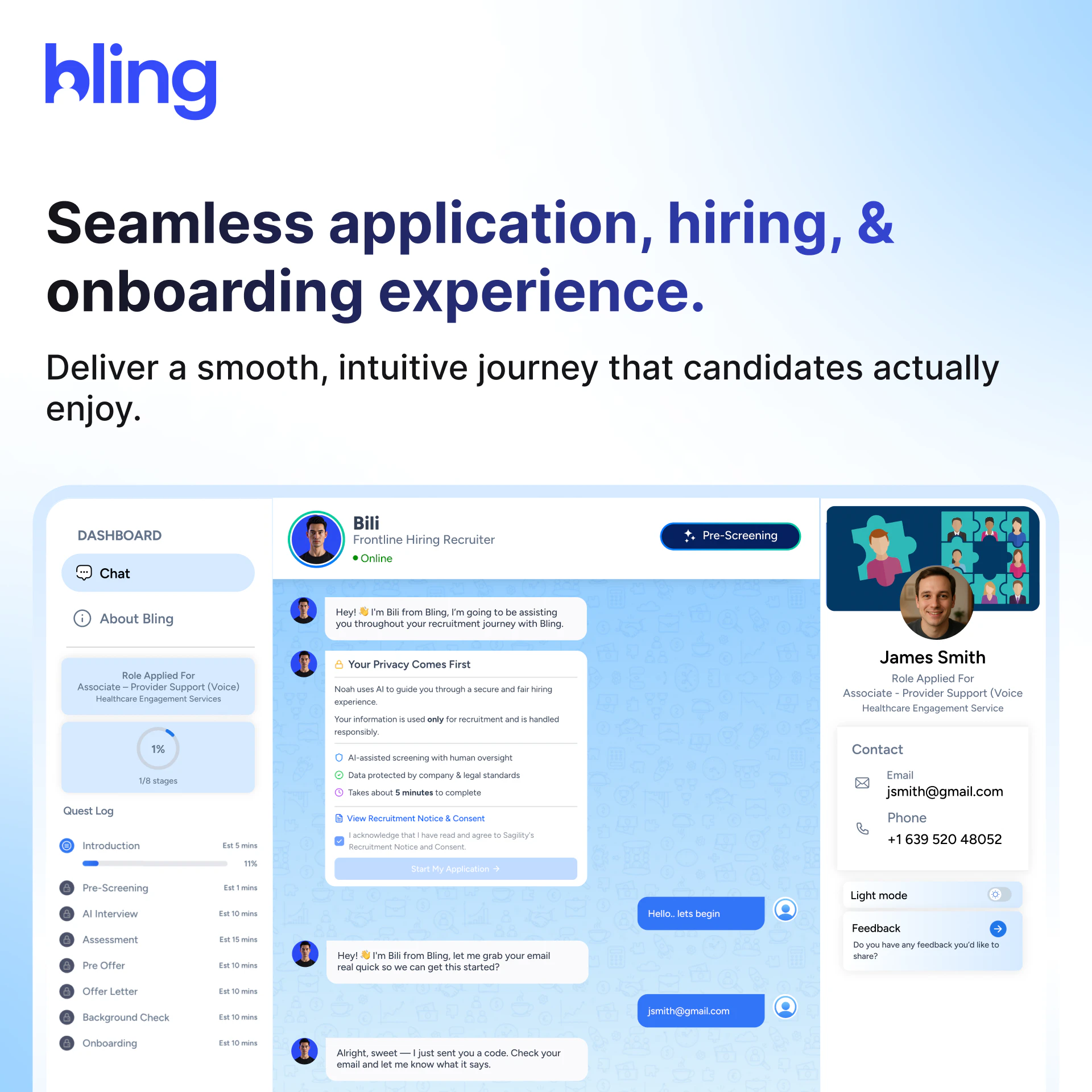
Run enterprise hiring loops autonomously
Bling is an innovative SaaS platform designed for large enterprises aiming to streamline and automate their frontline hiring processes. By leveraging advanced AI, Bling manages the entire recruitment cycle—from application receipt and screening to interviews, offer rollouts, background checks, and onboarding—without human intervention. Its AI system can engage with thousands of candidates simultaneously, moving them through the hiring pipeline in under 10 minutes, significantly reducing time-to-hire and operational costs. With over 1 million applicants processed, Bling continuously enhances its data and AI intelligence through its proprietary flywheel, making it increasingly efficient and accurate over time. Ideal for organizations with high-volume hiring needs, Bling offers a scalable, autonomous solution that ensures consistent hiring outcomes and reduces dependence on traditional recruitment methods.
Pros
- Automates the entire hiring process, saving time and resources
- Handles high-volume candidate engagement simultaneously
- Reduces time-to-hire to under 10 minutes
- Learns and improves continuously through its AI flywheel
- Owns the outcome, ensuring a person is hired
Cons
- Potentially limited customization for unique or niche roles
- May require integration efforts with existing HR systems
- Uncertain how it handles complex or nuanced candidate evaluations
Best for
- • High-volume frontline worker recruitment for retail, hospitality, or logistics
- • Automating mass hiring campaigns during peak seasons
- • Reducing administrative burden in large enterprise HR departments
- • Rapid onboarding of temporary or seasonal staff
Pricing: Pricing details are not publicly disclosed, but the platform likely offers a subscription-based model with tiered plans based on volume and features, suitable for large enterprises with high hiring demands.

Build teams of humans and agents, watch them work.
Offsite revolutionizes team collaboration by integrating humans and AI agents into a unified, real-time workspace. Unlike traditional tools that silo agents in separate tabs or terminals, Offsite visualizes the entire team in a live organizational chart, enabling seamless coordination and communication. Users can see every conversation, approve real-world actions, and maintain full visibility and control over team operations. Its out-of-the-box integrations with popular agents like Claude Code and OpenClaw make it adaptable for various AI workflows. Designed for teams seeking to harness the power of AI alongside human collaboration, Offsite offers a fresh approach to managing hybrid teams, fostering transparency, and streamlining workflows in a single, intuitive platform.
Pros
- Real-time visualization of team structure and activities
- Seamless integration with popular AI agents
- Full visibility and control over conversations and actions
- Brings humans and AI agents into a unified workspace
- Supports dynamic team organization with live org charts
Cons
- New paradigm may require a learning curve for traditional teams
- Potential limitations in customization or integrations outside supported agents
- Pricing details are not explicitly disclosed, which may affect budgeting
Best for
- • Managing AI-human hybrid teams for customer support or sales
- • Coordinating complex projects involving multiple AI agents and human stakeholders
- • Monitoring and approving AI-driven actions in real time
- • Organizing R&D teams with integrated AI assistants for faster collaboration
Pricing: Likely employs a subscription-based model with tiered plans, possibly offering a free trial or freemium features. Exact pricing details are not publicly specified, but enterprise or larger team plans may incur higher costs based on usage and integrations.