Basedash Public Sharing vs Metabase Data Studio
Side-by-side comparison of features, pros & cons, pricing, and community votes (2026).
🏆 Metabase Data Studio leads with 163 upvotes
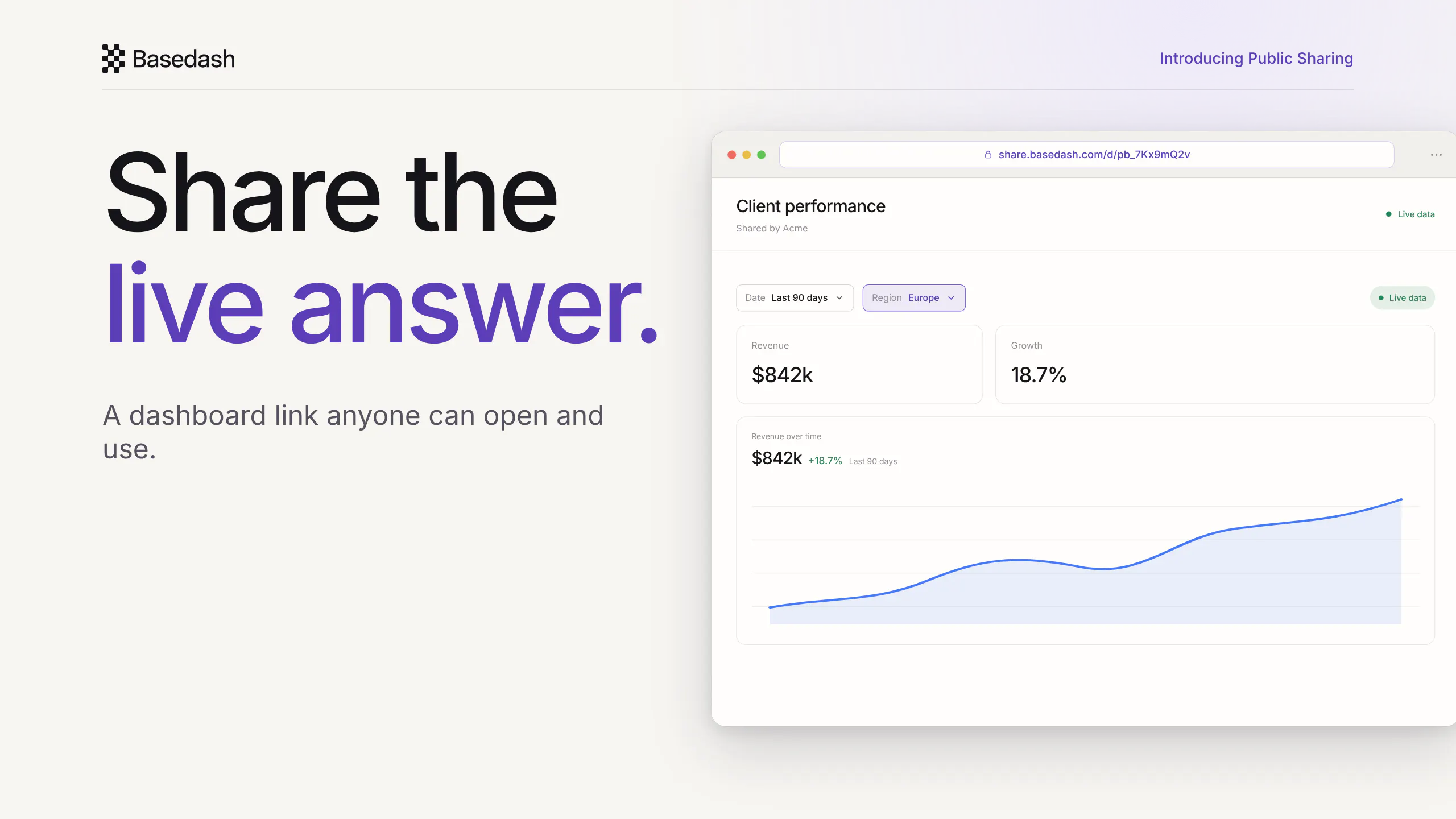
Live dashboards for anyone you send the link to
Basedash Public Sharing is a powerful tool that transforms static dashboards and charts into easily shareable, live web links. Designed for teams, analysts, and stakeholders, it allows users to instantly generate tokenized public links that enable recipients to explore real-time data without requiring a Basedash account. Whether sharing a complete dashboard or a single chart, the tool ensures that viewers can interact with filters, inspect data points, and view live updates seamlessly within their browsers. This eliminates the need for exports, screenshots, or manual data sharing, fostering more transparent and dynamic communication of insights. Its simplicity and real-time capabilities make it ideal for client updates, investor reports, or internal stakeholder communication, where quick access to current data is crucial. By focusing on live, interactive sharing, Basedash Public Sharing stands out as an innovative solution for making data accessible and engaging for anyone, anywhere.
Pros
- Enables real-time, interactive sharing of dashboards and charts
- No login required for viewers, simplifying access for stakeholders
- Supports sharing entire dashboards or individual charts
- Secure tokenized links ensure controlled access
- Eliminates the need for manual exports or screenshots
Cons
- Limited customization options for shared links
- Potential privacy concerns if links are not properly secured
- Features may be basic for advanced data governance needs
Best for
- • Sharing live dashboards with clients for real-time updates
- • Providing investors with interactive access to financial data
- • Internal team collaboration on dynamic performance metrics
- • Stakeholder presentations requiring current data insights
Pricing: Likely operates on a freemium model, offering basic sharing capabilities for free and charging for advanced features or higher usage tiers. Specific pricing details are not publicly disclosed but may start with free plans and scaled paid options.

Build the semantic layer that makes AI analytics trustworthy
Metabase Data Studio is an innovative platform designed to establish a robust semantic layer for AI-driven analytics. By enabling organizations to define and manage core metrics, business logic, and data transformations in one centralized location, it ensures consistent and trustworthy insights. The tool caters primarily to data analysts, business intelligence teams, and developers who need to build reliable, shared understanding across their data ecosystem. Its user-friendly interface allows users to define metrics once, transform raw data using SQL or Python, and visualize dependencies before making changes, reducing errors and ensuring data integrity. Publishing trusted definitions to a library ensures all stakeholders work from the same foundation, making AI analytics more accurate and meaningful. Overall, Data Studio enhances the quality and trustworthiness of AI insights by simplifying the creation and maintenance of a unified semantic layer, fostering better decision-making at scale.
Pros
- Centralized semantic layer for consistent metrics and business logic
- Supports SQL and Python transformations for flexibility
- Dependency visualization helps prevent errors before changes
- Easy publishing and sharing of trusted data definitions
- Enhances the reliability of AI-powered analytics
Cons
- May require technical expertise for complex SQL/Python configurations
- Limited information on pricing and scalability options
- Potential learning curve for new users unfamiliar with semantic layers
Best for
- • Building a shared set of key metrics across an organization
- • Ensuring data consistency for AI and machine learning models
- • Transforming raw data into business-ready metrics
- • Collaborative data governance and version control
Pricing: Likely follows a SaaS subscription model with tiered plans based on user count, data volume, or features. Specific pricing details are not publicly disclosed, but the platform may offer a free trial or open-source components.