Ainux Domain Intelligence vs Littlebird
Side-by-side comparison of features, pros & cons, pricing, and community votes (2026).
🏆 Littlebird leads with 712 upvotes
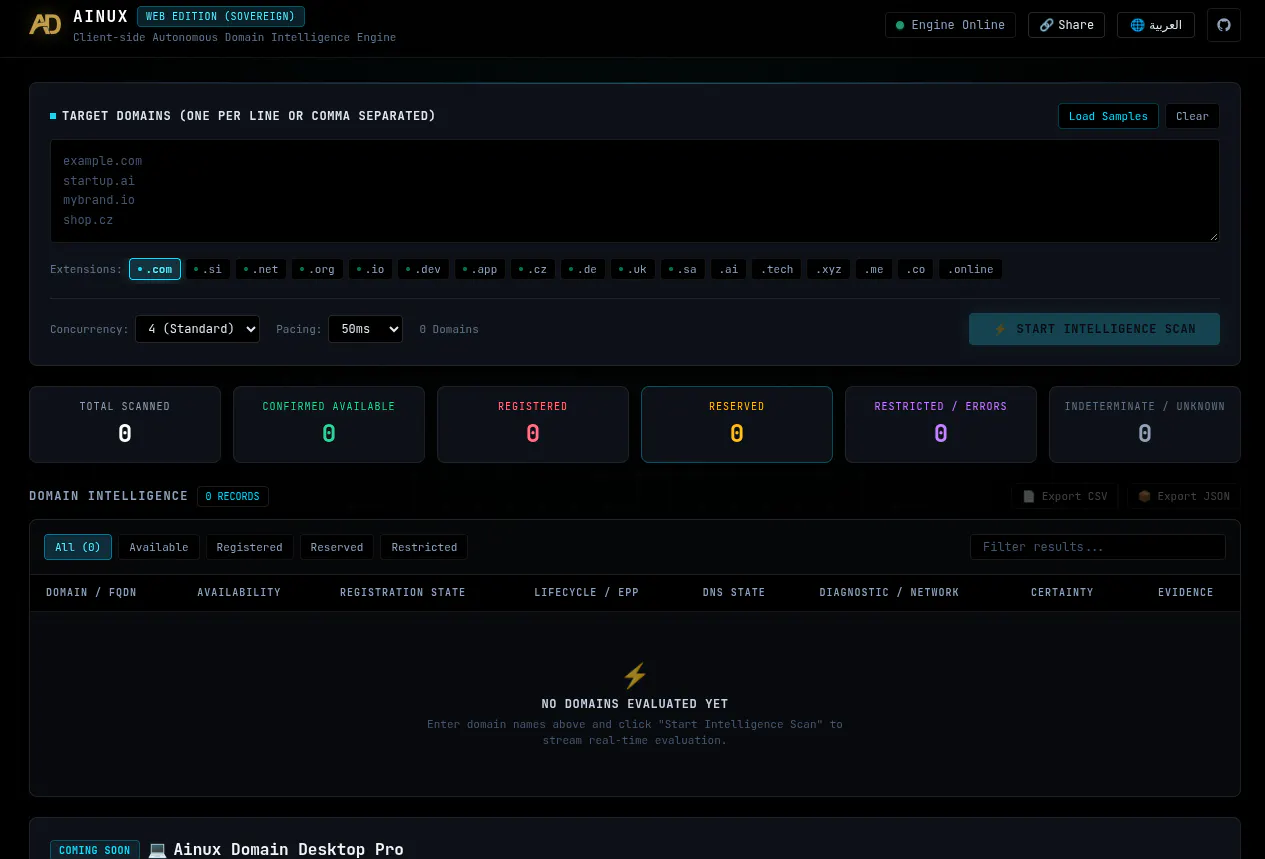
Privacy-first domain research, powered by WebAssembly
Ainux Domain Intelligence is a privacy-first domain research tool designed for professionals who need efficient and secure domain analysis. Built as a browser-native application, it leverages WebAssembly and Web Workers to run its core engine locally, ensuring that sensitive data remains private and does not pass through external servers. This architecture allows users to perform large-scale bulk domain scans—such as analyzing thousands of domains—in mere seconds, demonstrated by its ability to process 2,500 domains in just 37.7 seconds. Its emphasis on privacy, combined with high performance, makes it an attractive option for security researchers, digital marketers, and developers who prioritize data security and speed. The tool’s unique approach to local processing sets it apart in the domain research space, eliminating concerns about data leaks or reliance on third-party backend servers.
Pros
- Privacy-focused with local WebAssembly processing
- High-speed bulk domain scanning capabilities
- Browser-native, no installation required
- Supports large-scale domain research efficiently
- Reduces reliance on external backend servers for data processing
Cons
- Limited information on detailed feature set or integrations
- No user reviews or ratings available yet
- Potential learning curve for non-technical users
Best for
- • Bulk domain research for cybersecurity assessments
- • Digital marketing and SEO domain analysis
- • Brand monitoring and domain portfolio management
- • Competitive intelligence gathering
Pricing: Pricing not verified

The AI assistant that already knows your work
Littlebird is an AI-powered virtual assistant designed to seamlessly integrate with your workflow by understanding the context of your work. Unlike traditional assistants, Littlebird builds a private memory of your projects, meetings, and priorities by observing your screen activity and transcribing conversations. It connects the dots across various apps and conversations, providing highly relevant answers and suggestions grounded in your actual work environment. Its ability to operate without requiring integrations makes it particularly user-friendly and easy to set up, appealing to professionals who want a smarter, more intuitive assistant that adapts to their needs. Whether you're managing projects, preparing drafts, or seeking quick insights, Littlebird aims to streamline your productivity with personalized support based on your unique work habits.
Pros
- Built-in context awareness, reducing the need for manual input
- No integrations required, easy to use out of the box
- Transcribes meetings and captures screen activity automatically
- Creates a private, secure memory tailored to your work
Cons
- Limited details on pricing and subscription tiers
- Potential privacy concerns with screen and meeting monitoring
- May require consistent screen activity for optimal performance
Best for
- • Summarizing meeting notes and transcriptions
- • Drafting emails or documents based on ongoing work
- • Getting project-specific insights and answers
- • Managing and tracking work priorities across multiple apps
Pricing: Likely follows a freemium model with free access and paid plans offering additional features or increased usage, but specific details are not publicly confirmed.