AI Council vs 1Code
Side-by-side comparison of features, pros & cons, pricing, and community votes (2026).
🏆 1Code leads with 598 upvotes
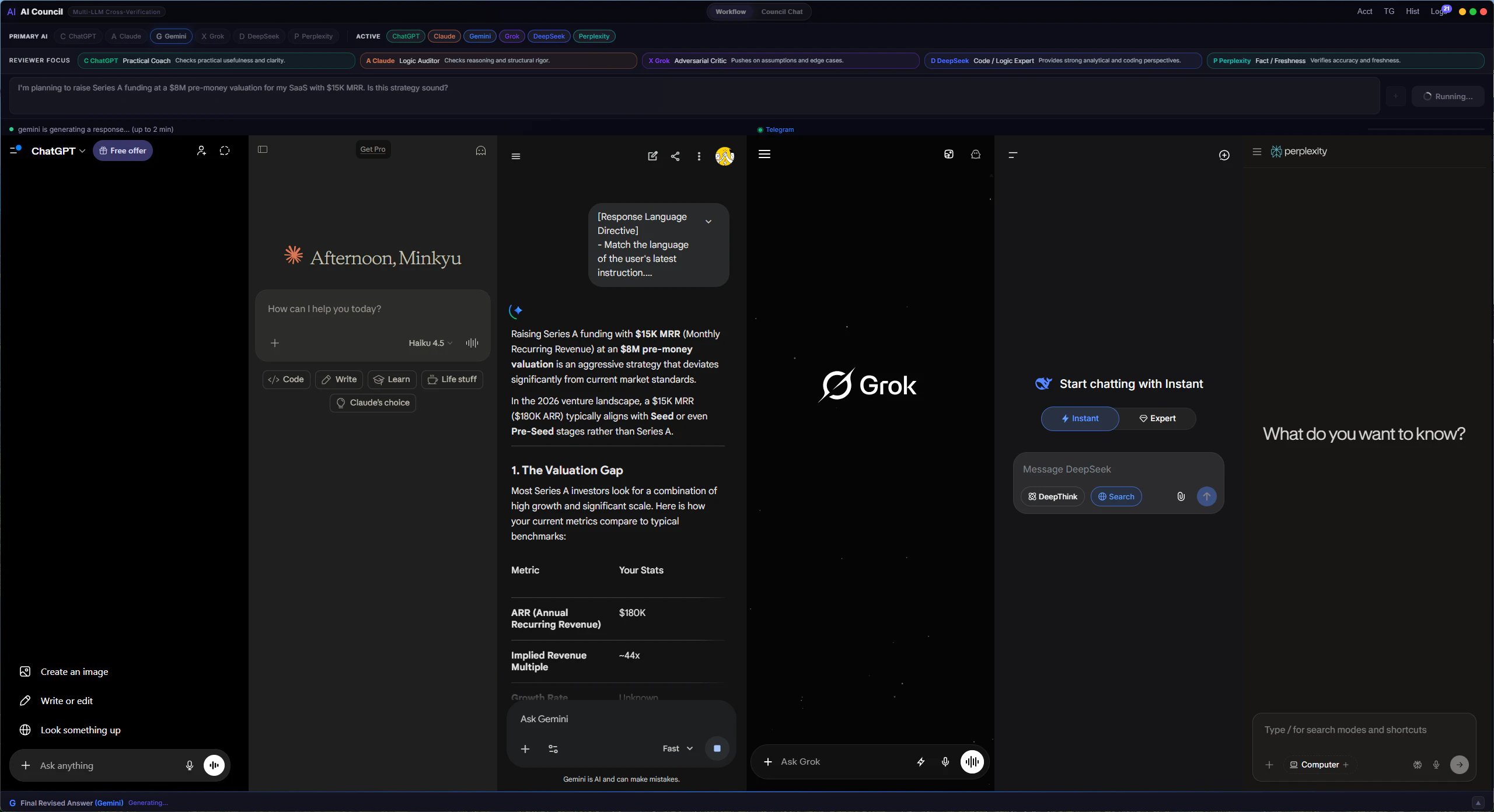
Local multi-agent council that bypasses API costs.
AI Council is a innovative multi-agent platform designed for developers, researchers, and AI enthusiasts seeking cost-effective access to multiple AI models like ChatGPT, Claude, and Gemini. Unlike traditional methods that require separate API calls and incur high costs, AI Council runs these models locally through DOM injection, effectively bypassing API fees. It orchestrates a peer-review process among AIs, allowing them to validate and stress-test each other's outputs, resulting in more reliable and thoroughly vetted answers. This approach makes AI Council especially appealing for users who need extensive AI testing, comparative analysis, or want to integrate multiple models into their workflow without the recurring API expenses. Its unique local execution and multi-agent coordination set it apart from standard API-based AI tools, providing a powerful solution for advanced AI experimentation and productivity.
Pros
- Reduces API costs by running models locally via DOM injection
- Supports multiple AI models simultaneously for comparison and validation
- Automates peer-review among AIs for more robust answers
- Ideal for developers, researchers, and AI power users seeking cost efficiency
- Streamlines multi-model workflows without API rate limits
Cons
- Requires some technical knowledge to set up and operate
- Limited information on the platform's stability and ongoing support
- Potential performance constraints depending on local hardware
Best for
- • Cost-effective multi-model AI testing and comparison
- • Automated peer-review for high-stakes or complex queries
- • Developing AI-powered applications with diverse model integrations
- • Research projects requiring stress-testing and validation of AI outputs
Pricing: Likely operates on a freemium model, offering basic features for free with premium options for advanced functionalities or enhanced performance. Precise pricing details are not publicly specified.

Open source Cursor-like UI for Claude Code
1Code is an innovative open source UI tool designed for developers working with Claude Code, an AI coding assistant. It offers a Cursor-like interface that enables users to run multiple Claude Code agents simultaneously, significantly accelerating feature development and testing. Available on Mac and Web, 1Code provides the flexibility to run locally or remotely, with live previews for mobile and desktop, making it easy to monitor agents from anywhere. Its parallel execution capability is particularly beneficial for teams seeking to streamline AI-driven coding workflows, enabling faster iteration and more efficient collaboration. The tool's user-friendly interface and cross-platform support make it an appealing choice for AI developers, coding enthusiasts, and teams integrating Claude Code into their development stacks.
Pros
- Supports parallel execution of multiple Claude Code agents, boosting productivity
- Cross-platform compatibility: works on Mac and Web with live preview features
- Open source, allowing for customization and community-driven improvements
- User-friendly, Cursor-like UI simplifies managing multiple agents
- Enables remote monitoring and testing, including mobile previews
Cons
- Primarily focused on Claude Code, limiting versatility with other AI models
- May require some technical expertise to set up and customize
- Limited detailed documentation available for advanced features
Best for
- • Parallel testing and debugging of AI coding agents
- • Accelerating feature development with multiple Claude Code instances
- • Remote monitoring of AI agents during development on multiple devices
- • Integrating AI code assistants into local and cloud-based workflows
Pricing: Likely free and open source, offering users the ability to customize and deploy without licensing costs. Additional features or enterprise support may be available through community or third-party services.