AfterStorm vs Claude Opus 4.6
Side-by-side comparison of features, pros & cons, pricing, and community votes (2026).
🏆 Claude Opus 4.6 leads with 780 upvotes
Find help. Give help. Recover.
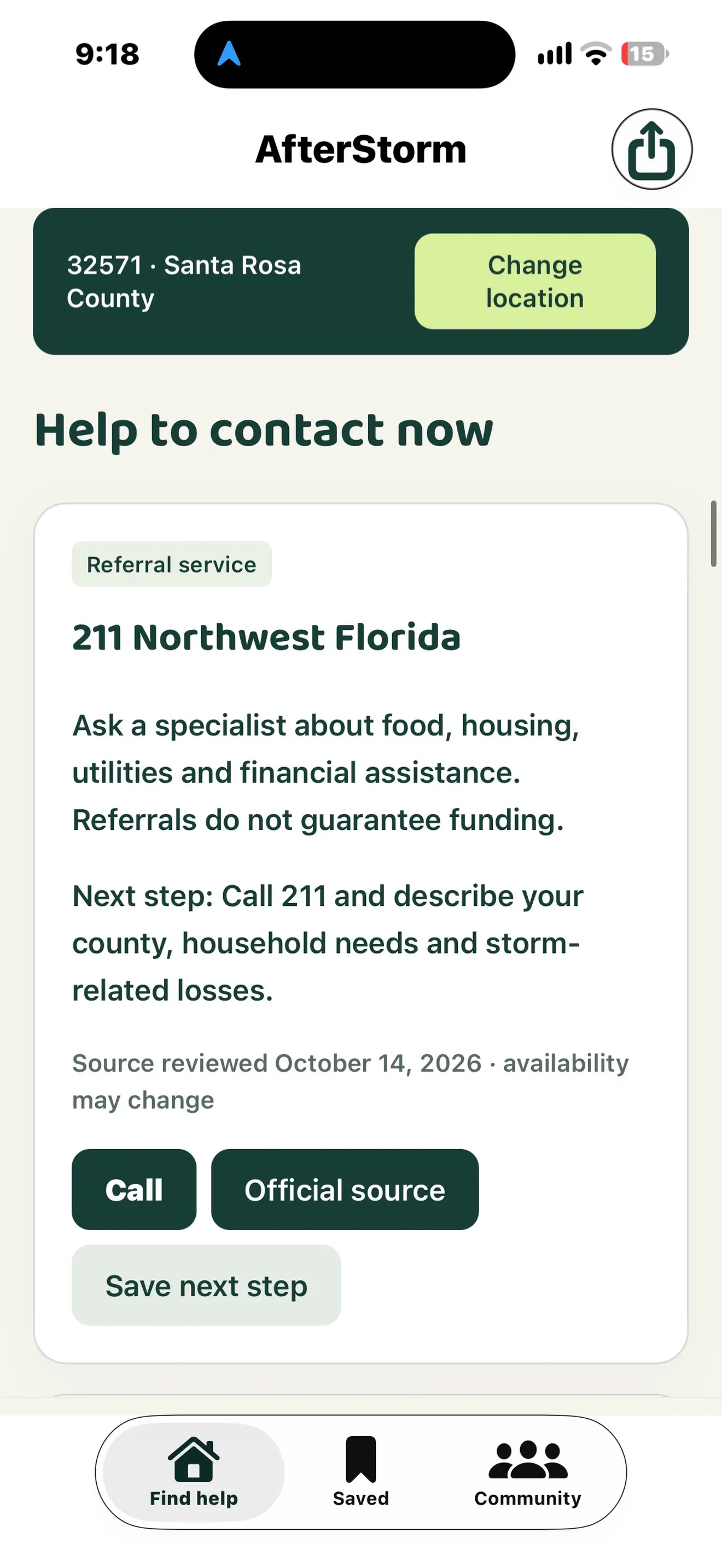
AfterStorm is a compassionate web app designed to assist families in navigating recovery resources after a disaster. By simply entering their ZIP code and confirming their county, users can easily find tailored support options such as food aid, cleanup assistance, and financial help. The platform provides localized listings for Santa Rosa and Escambia, FL, while offering national pathways for other U.S. counties, making it a versatile tool for disaster recovery across the country. Its user-friendly interface guides families step-by-step, ensuring they access the most relevant resources without the need for an account or personal data sharing. Built by a Florida Panhandle family who experienced disaster firsthand, AfterStorm emphasizes privacy and accessibility, with a private recovery tracker stored only in the user’s browser. An iOS app is also in development, broadening its reach and convenience. Overall, AfterStorm is a thoughtful, community-driven solution that empowers families to find help and support efficiently during difficult times.
Pros
- User-friendly, step-by-step guidance tailored to local needs
- No account or personal data collection ensures privacy
- Localized resources for specific communities and national pathways for others
- Built by a family with firsthand disaster experience, adding authenticity
- Free to use, making it accessible to all families in need
Cons
- Currently lacks an iOS app, which may limit mobile accessibility for some users
- Limited information on the size and scope of available resources
- No user ratings or reviews available yet, which could impact trust
Best for
- • Families seeking immediate disaster recovery resources in their local area
- • Community organizations coordinating aid and volunteer efforts
- • Individuals planning for disaster preparedness and resource access
- • Local governments or agencies providing support and information
Pricing: Pricing not verified

Claude’s most advanced model for agentic tasks
Claude Opus 4.6 stands out as one of the most advanced AI models from Anthropic, designed specifically for complex, agentic tasks that require deep reasoning and sustained focus. With a staggering 1 million token context window, it excels at handling large codebases, lengthy research documents, and multi-step reasoning processes. Its adaptive thinking capabilities and improved planning enable it to perform reliably across diverse tasks such as coding, analysis, and real-world problem solving. This makes Claude Opus 4.6 ideal for developers, researchers, and enterprise users seeking a powerful AI assistant capable of managing long-term projects and intricate workflows. Its emphasis on safety and reliability also makes it suitable for high-stakes environments where accuracy matters. Overall, Claude Opus 4.6 pushes the boundaries of AI’s capacity for agentic tasks, offering a highly capable solution to those demanding state-of-the-art performance in AI-driven tasks.
Pros
- Exceptional long-context handling with 1M token window
- Advanced reasoning and planning capabilities
- Ideal for complex, multi-step tasks and large codebases
- Adaptive thinking enhances problem-solving flexibility
- Suitable for research, coding, analysis, and real-world applications
Cons
- Potentially high cost due to its advanced capabilities
- May require technical expertise to fully leverage features
- Limited information on availability and deployment options
Best for
- • Managing and analyzing large codebases for developers
- • Conducting in-depth research and data analysis
- • Automating complex agentic workflows
- • Supporting long-term projects requiring sustained reasoning
Pricing: While specific pricing details are not publicly disclosed, tools of this caliber typically operate on subscription or usage-based models, often with premium tiers for higher capacity or enterprise features. Expect a pricing structure that reflects its advanced capabilities and extensive context window.